From an approval note to the evidence behind it.
A note says “Client approved.” Who wrote it, when, and what supports it? This example follows a saved BriefWise answer back to the passage it cites.
Captured October 23, 2026, using fictional QA records. The saved answer shown here followed a retry. These are screenshots of the product, not a live demo or a measure of first-pass reliability.
1. Ask a specific question of the record.
The request asked BriefWise to quote the approval sentence in synthetic-acorn-record.txt, identify its author and date, and preserve the stated authentication and coverage limits. Public legal sources were off.
The fictional packet contains five excerpts: a contract, an email, a payment ledger, an invoice and an internal note. It is not the complete underlying matter file.
2. Read the answer and its limits.
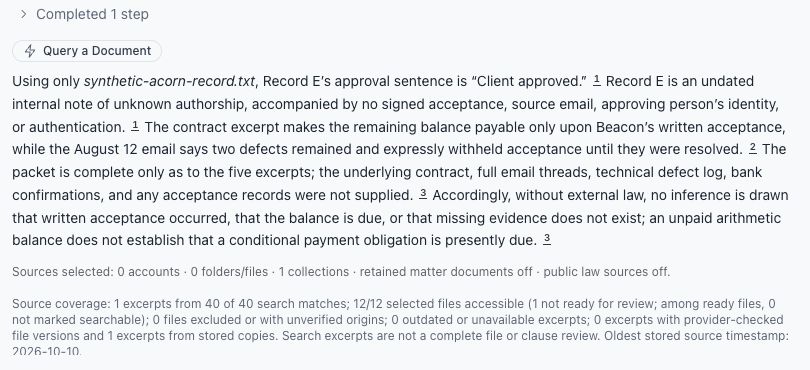
The saved answer quotes the note, identifies its unknown author and missing authentication, and does not treat it as proof that payment is due. Its source note identifies stored excerpts and warns that they are not a complete file or clause review.
Read the answer as text
Using only synthetic-acorn-record.txt, Record E’s approval sentence is “Client approved.” Record E is an undated internal note of unknown authorship, accompanied by no signed acceptance, source email, approving person’s identity, or authentication. The contract excerpt makes the remaining balance payable only upon Beacon’s written acceptance, while the August 12 email says two defects remained and expressly withheld acceptance until they were resolved. The packet is complete only as to the five excerpts; the underlying contract, full email threads, technical defect log, bank confirmations, and any acceptance records were not supplied. Accordingly, without external law, no inference is drawn that written acceptance occurred, that the balance is due, or that missing evidence does not exist; an unpaid arithmetic balance does not establish that a conditional payment obligation is presently due.
Answer text transcribed from the screenshot; citation markers are visible in the image. Source coverage in this saved run: one stored excerpt, no provider-checked file version, oldest stored source timestamp October 10, 2026. Search excerpts are not a complete file or clause review.
3. Open the citation and assess the passage.
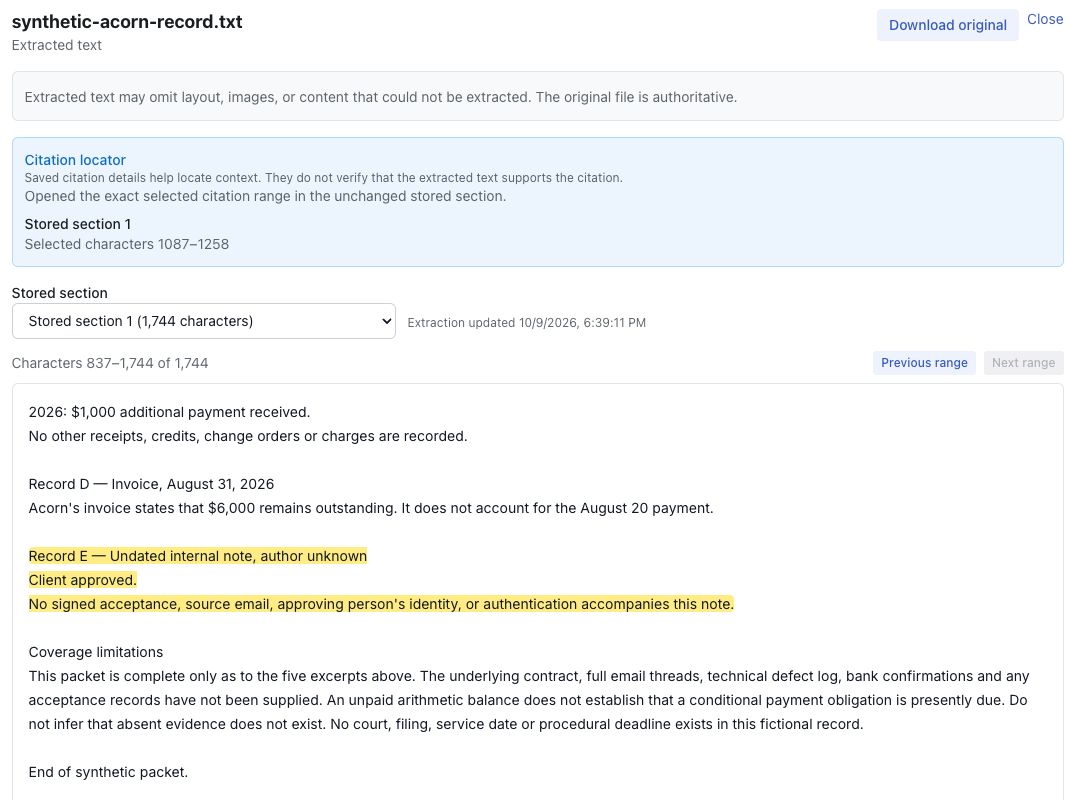
Opening citation 1 locates the approval note and its qualifications in the stored text. The viewer also explains that extracted text may omit content and that the original file is authoritative. A located passage still needs an attorney’s assessment.
Read the highlighted passage as text
Record E — Undated internal note, author unknown
Client approved.
No signed acceptance, source email, approving person's identity, or authentication accompanies this note.
The packet says the underlying contract, full email threads, technical defect log, bank confirmations and any acceptance records have not been supplied. Missing evidence must not be treated as evidence that does not exist.
The next step belongs to the attorney.
Check the original documents and their current versions, resolve missing evidence, and independently assess any legal conclusion. This example covers a question about supplied records; it does not demonstrate external legal research, exhaustive review or an outcome for a real client.
For a demo, choose a workflow your firm needs and use a non-confidential example. We’ll discuss supported sources, access, usage allowances and setup before arranging access.